
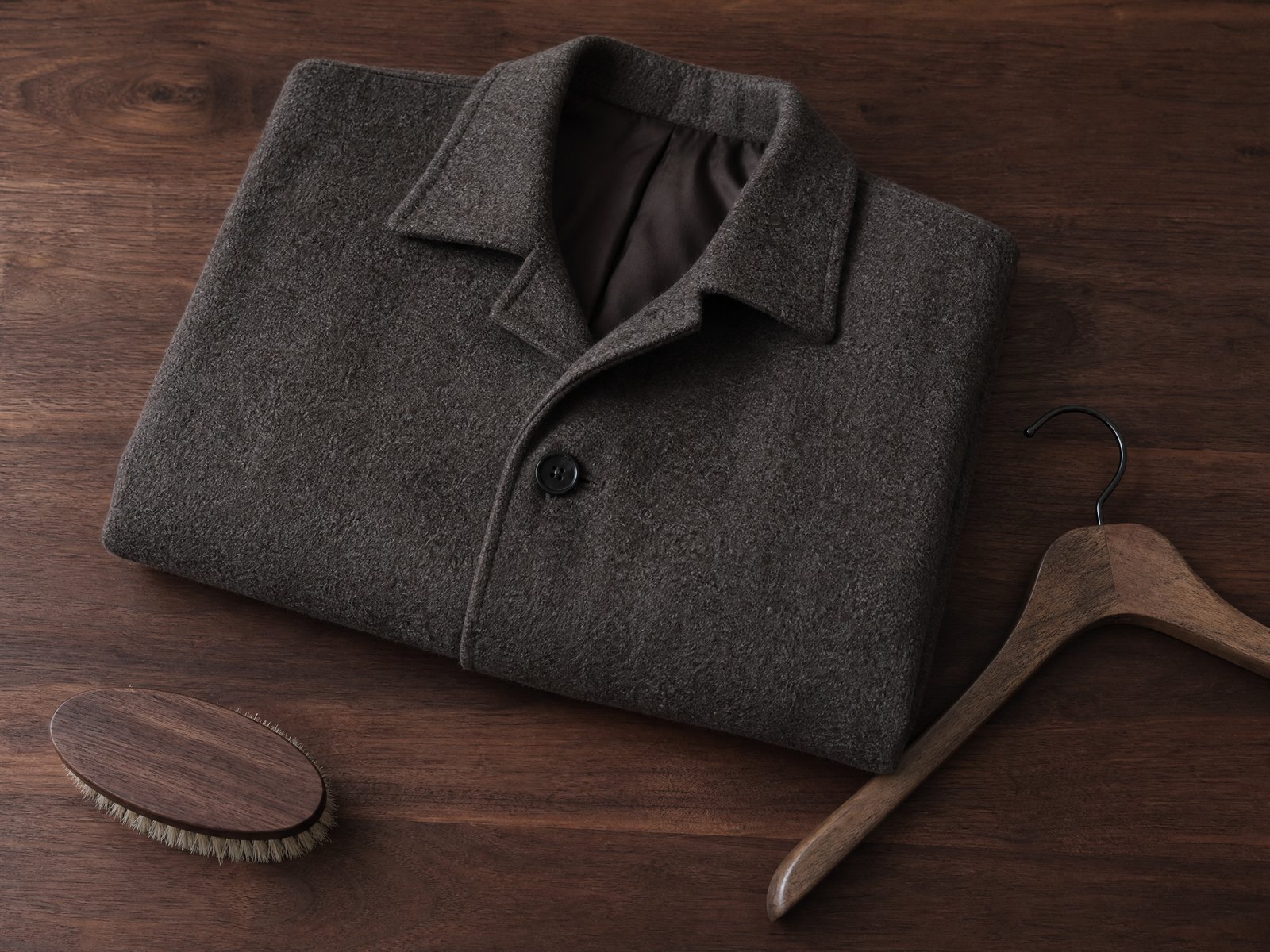
Looking after wool tailoring
Wool tailoring lasts for years when it is aired, brushed and pressed, and wears out quickly when it is cleaned too often. Dry cleaning solvent strips the natural oils from the fibre and repeated pressing at a shop flattens the lapel roll and shines the surface. Treat cleaning as an end-of-season job, not a routine one.
After every wear
Empty the pockets, unbutton the jacket and hang it on a shaped wooden hanger wide enough to support the shoulder. Wire hangers crease the shoulder pad and leave a dent that will not press out. Give the garment 24 hours before wearing it again so the fibres can recover; if you wear tailoring daily, rotate two or three pieces rather than one. Hang trousers from the hems in clip hangers so gravity pulls the crease straight, or fold once along the crease over a bar. Never fold trousers across the knee.
Brushing
Use a soft natural-bristle clothes brush and work in short strokes in the direction of the weave, from the shoulder down. Brushing lifts dust and city grit out of the surface, and grit is what abrades wool fibres and eventually thins the cloth at the elbow and seat. Brush the collar, the inside of the cuffs and the back of the trouser hem, which pick up the most dirt. A lint roller flattens the surface and does not remove grit; a brush does both jobs properly.
Airing and steam
Hang the garment in a bathroom after a hot shower for ten minutes, or pass a hand steamer 15cm from the surface, and light creases will fall out on their own. Do not steam a lapel flat: hold the steamer away from the roll line and let the shape stay. Air overnight near an open window rather than in a sealed wardrobe to clear smoke or cooking smells; wool releases odour readily.
Pressing at home
Press on the reverse where you can, or use a clean cotton pressing cloth on the face. Set the iron to the wool mark, roughly 150C, and use steam. Press, meaning lift and lower, rather than gliding: sliding the iron stretches the cloth on the bias. To sharpen a trouser crease, lay the leg flat with the seams aligned, lay a damp cloth over the crease and press until the steam stops rising. Press the waistband curtain on the inside only. Never iron directly onto a lining or a brass-finish zip.
Stains
Act while the mark is wet. Blot with a clean white cloth from the outside of the mark inwards; rubbing spreads it and felts the surface. Water-based spills usually lift with cold water and blotting alone. For grease, dust the mark with talc, leave it an hour to draw the oil out, brush off and take the piece to a cleaner if a shadow remains. Do not use household stain removers on wool: most contain alkali or bleach that will strip the dye and leave a pale ring worse than the original mark.
Dry cleaning
Jackets, trousers, waistcoats and skirts in wool or wool-linen are dry clean only. Clean them once or twice a year, or when there is a real mark, and ask for a hand finish rather than a press machine so the lapel roll and the pocket lines survive. Point out any stain and say what caused it. Remove the plastic bag as soon as you get the garment home; it traps solvent vapour and moisture against the cloth.
Shirts
Cotton shirts machine wash at 30C on a normal cycle with similar colours, no fabric softener, no bleach. Close the cuffs, unfasten the collar button and wash inside out to protect the collar edge. Line dry rather than tumble drying, which shrinks cotton and wears the collar band; if you must tumble, use a cool setting and take the shirt out damp. Iron damp on a hot setting: collar from the points inwards, then cuffs, then sleeves, then the back and fronts. Hang immediately and leave the top button open.
Storage
Store clean, never dirty. Moth larvae feed on the residue in soiled wool, not on the fibre itself, so an unwashed jacket left over summer is the highest risk in the wardrobe. Use cedar blocks or lavender sachets, refresh them every few months by sanding or squeezing, and keep the wardrobe dry and lightly ventilated. Give each garment 3cm of air on either side. For long storage, use a breathable cotton garment bag, not plastic. Fold knits and shells flat; hang tailoring. Questions about a specific piece can go to support@crowntailoring.shop, and full care notes sit on every product page at https://crowntailoring.shop.
CROWN TAILORING LIMITED
Company number 17256281, registered in England and Wales.
Registered office: 303C Green Lanes, London, N13 4XS, England
Email: support@crowntailoring.shop
CROWN TAILORING LIMITED is not currently registered for VAT. No VAT is charged on the prices shown on this website.