
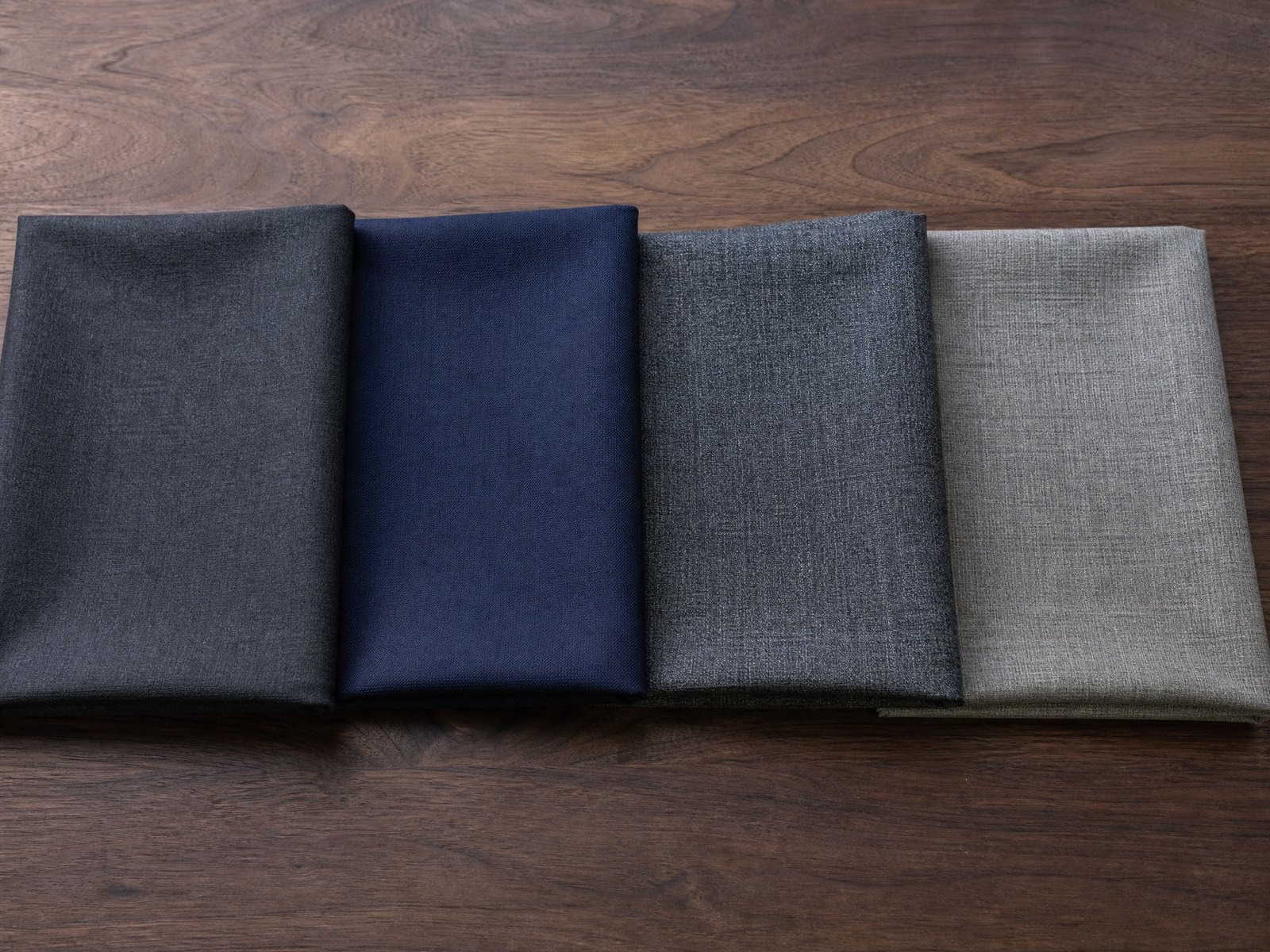
The cloth we buy and why
Almost everything we cut is worsted wool. Worsted yarn is combed so the fibres lie parallel before spinning, which gives a smooth, dry surface, a clean pressed edge and the crease recovery that tailoring depends on. Woollen yarn, by contrast, is carded rather than combed: warmer and softer, but it blurs a pressed line. If you want a jacket whose lapel still rolls in the same place after two years, worsted is the correct choice, and that is what our suppliers in Yorkshire, the Scottish Borders and Biella weave for us.
Weight
Weight is quoted in grams per metre and it decides how a garment behaves more than the fibre content does. We cut jackets, skirts and waistcoats mostly in the 280gsm to 320gsm range and trousers in 260gsm to 300gsm. Below about 240gsm a wool cloth is comfortable in July but will not hold a shoulder line or a trouser crease; above 360gsm the garment is genuinely warm and heavy to wear indoors. A 300gsm plain-weave wool is the honest all-year cloth in the UK: warm enough in March, wearable in September, and stable enough to press hard.
Yarn twist and the crease question
High-twist yarns are spun tighter, which makes the cloth springier and far more resistant to creasing behind the knee and at the elbow. The trade-off is hand: a high-twist wool feels crisp and slightly wiry on the roll rather than soft. We choose it deliberately for travel-friendly trousers and for the wide-leg, and we accept that it feels less luxurious in the hand than a low-twist cloth that will crumple by lunchtime. Fineness is quoted as Super 100s, 110s and so on, and it measures fibre diameter, not quality: a Super 150s cloth is softer and drapes beautifully, but the fibre is thinner and wears through sooner at the seat and elbow. For pieces intended for daily use we stay between Super 100s and Super 120s on purpose.
Wool blends
Wool-mohair, usually 70/30, appears in our evening waistcoats and double-breasted jackets. Mohair is a lustrous goat fibre that adds a dry crispness and a faint sheen, holds a sharp edge and resists creasing better than pure wool. It is also slightly scratchy against bare skin, which is why we use it in lined pieces only. Wool-linen at roughly 60/40 is the summer cloth: linen brings breathability and a slubby, matte texture, and it crumples freely. That crumple is the character of the cloth, not a fault, and it is the reason we do not use wool-linen for anything that has to look pressed all day. Wool-viscose adds fluid drape and lowers cost, but it has less recovery, so we keep it to trousers with a softer intended fit. Where a piece needs to move, we specify 2% to 4% elastane: it makes a close-cut trouser or pencil skirt genuinely wearable and relaxes about 1cm through the waist during wear. The cost is longevity, because elastane degrades faster than wool, especially with heat, so those pieces should never go near a tumble dryer.
Shirting
Cotton poplin at 110gsm to 130gsm is a tight plain weave: crisp, cool, smooth and quick to show a crease. Cotton twill is a little heavier and softer, drapes better under a jacket and hides creasing well. Oxford weave is the most robust and the most casual, with a visible basket texture. Long-staple cotton costs more and pills less because there are fewer fibre ends at the surface. We do not treat shirting with easy-care resin finishes: they cut down ironing but stiffen the hand and weaken cotton fibres over repeated washing, so our shirts need a press and last longer for it.
Inside the garment
The parts you do not see matter as much as the face cloth. Jacket fronts are built on a half-canvas of horsehair and cotton, pad-stitched by hand through the lapel. Canvas is why a lapel rolls softly and springs back; a fused front, glued rather than stitched, is cheaper and lighter but eventually bubbles at the chest after cleaning. Linings are cupro or viscose twill, both cellulose fibres chosen because they breathe and slide over a sleeve better than polyester, and both are worth replacing after several years rather than replacing the jacket. Pocketing is cotton, waistband curtains are stiffened cotton, and hardware is brass-finish: zips, hooks and bars. Buttons are horn-look polyester on wool pieces and mother-of-pearl-look on shirts, sewn with a shank so they sit correctly through a buttonhole.
Honest limitations
Wool pills lightly where it rubs, usually at the seat and under the arm, and the pills can be shaved off with a fabric comb. Dark ink black fades gradually in strong sunlight, so store pieces away from a bright window. Wool-linen creases. High-twist wool feels dry. None of these are faults, and knowing them is the difference between a garment that lasts a decade and one that disappoints in a season. Fibre content sits on every product page at https://crowntailoring.shop; if you want the weight and weave of a specific piece before ordering, email support@crowntailoring.shop and we will read it off the roll ticket.
CROWN TAILORING LIMITED
Company number 17256281, registered in England and Wales.
Registered office: 303C Green Lanes, London, N13 4XS, England
Email: support@crowntailoring.shop
CROWN TAILORING LIMITED is not currently registered for VAT. No VAT is charged on the prices shown on this website.